From Vibe Coding to Agentic Engineering
Vibe codingAgentic engineeringAiEngineeringProductivityCursor

Photo by Ales Nesetril on Unsplash
My Production Workflow Using v0 and Cursor
AI coding has evolved fast.
What started as vibe coding — prompt, paste, tweak — is turning into something more structured: Agentic Engineering.
By Agentic Engineering, I mean software engineering where AI agents perform multi-step tasks, reason through constraints, and interact with the file system, while the human acts as the system architect.
Vibe coding feels powerful.
Agentic Engineering ships reliably.
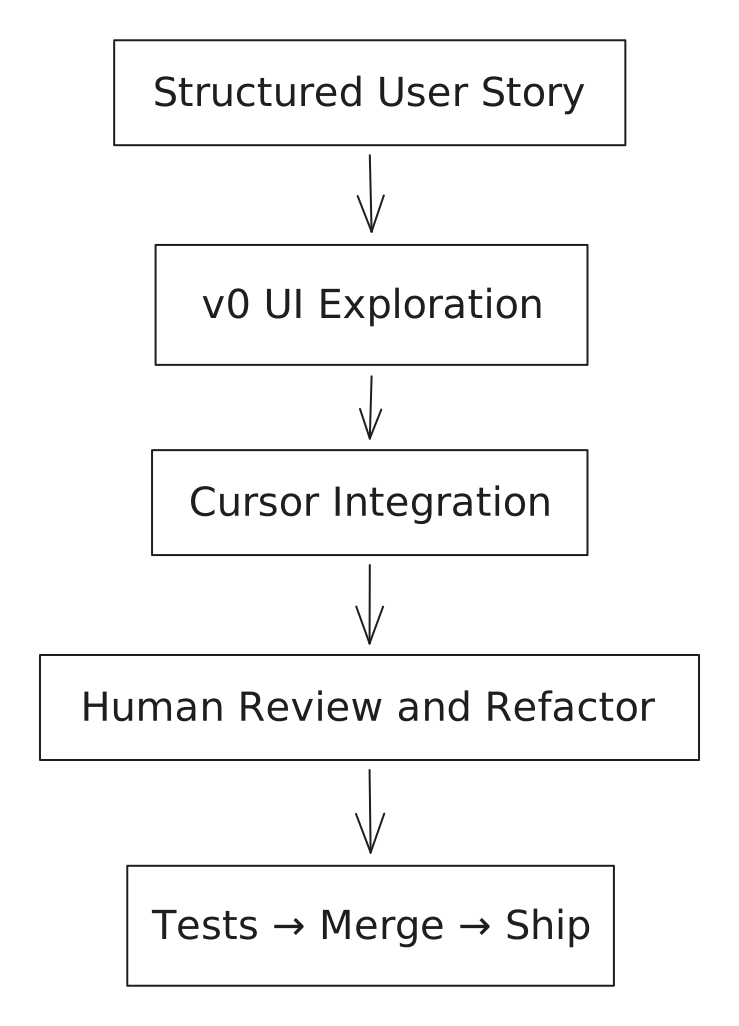
In this post, I’ll walk you through the workflow I use to move from idea to production:
- Structured feature definition
- UI exploration in v0
- Integration in Cursor
- Human review and refactoring
- What didn’t work (and how I adapted)
This isn’t theory. It’s the system I use to ship real features.
The Shift: From Vibe to Structure
Vibe coding looks like this:
“Build a workout overview page with filters and charts.”
Prompt.
Copy.
Adjust.
Repeat.
It works surprisingly well — until it doesn’t.
The problems show up when:
- The feature must live long-term
- Architecture matters
- Responsive behavior gets complex
- Multiple engineers touch the code
Agentic engineering adds discipline:
- Clear goals before generation
- Tool separation
- Controlled integration
- Mandatory human review
You stop prompting randomly.
You start orchestrating.
The Workflow
Step 1 — Structured User Story
Everything starts with clarity.
Before opening v0 or Cursor, I generate a structured feature definition using ChatGPT or Gemini.
I want:
- Context
- User persona
- Detailed functional requirements
- Non-functional constraints
- Edge cases
- Acceptance criteria
This dramatically improves output quality downstream.
If you’ve read my model benchmark, you’ve seen how reasoning quality differs across models. Structured input amplifies those differences.
👉 Related: Latest LLMs in the Test: GPT 5.1 Codex Max vs. Gemini Pro 3 vs. Opus 4.5
Full Structured User Story Prompt Template
You can copy this directly:
I want to define a new feature for my application.

Please generate a structured user story with:

1. Context
2. User Persona
3. Problem Statement
4. Goal / Desired Outcome
5. Functional Requirements
6. Non-Functional Requirements
7. Edge Cases
8. Data & State Requirements
9. Acceptance Criteria
10. Suggested Component Structure (no implementation code)

Format in Markdown with clear headings.
Be specific and avoid generic phrasing.
This template forces depth before generation.
That’s where agentic engineering begins.
Lightweight Version (For Faster Iteration)
For internal tools or experiments, I use this:
Generate a concise structured user story including:

1. Goal
2. Target User
3. Core Requirements
4. Constraints
5. Edge Cases
6. Acceptance Criteria

Keep it short and specific.
Use lightweight for exploration.
Use full for production.
Step 2 — UI Exploration in v0
Once the feature is defined, I move to v0.
Here I:
- Paste the structured user story
- Add branding screenshots
- Constrain layout
- Iterate until the hierarchy feels right
This is where vibe coding still shines — rapid iteration.
v0 can also generate implementation code and turn it into a pull request.
I recommend using that PR as the starting point, then iterating and hardening the result in Cursor.
Step 3 — Integration in Cursor
I never paste raw v0 output into production.
Instead, I treat it as design intent.
In Cursor:
- I build on top of the existing project
- I provide screenshots from the v0 design
- Use the existing PR from v0
- I provide clear constraints
I usually start in Plan mode so Cursor can figure out the best implementation path first. I iterate on the plan until it fit's what I want.
From there, I build on top of the Pull Request generated by v0. In Cursor Plan mode, I re-verify the generated logic against existing types, conventions, and architecture.
This is a multimodal workflow: I give the model text plus screenshots, so it can reason with visual context instead of text alone.
Example integration instruction:
Goal: Implement this feature in the existing project.

Context:
- Existing codebase and architecture patterns are the source of truth.
- I attached screenshots as visual reference for layout, hierarchy, and UX details.
- Build on top of the code changes already present in this branch.

Requirements:
- Follow existing architecture and conventions.
- Reuse existing components/utilities where possible.
- Avoid introducing unnecessary dependencies.
- Refactor only where it clearly improves maintainability.
- Add or update tests for changed behavior.

Deliverables:
1. Short implementation plan.
2. Production-ready code changes.
3. Brief explanation of architectural decisions and trade-offs.
This step transforms generated UI into maintainable software.
If you’ve read my frontend generator comparison, you know different tools produce very different structural quality.
👉 Related: AI Frontend Generator Comparison: Claude Code vs v0 vs Cursor vs Replit
Integration is where those differences really show.
Where I can still improve this workflow:
I can make this process more repeatable by codifying standards in .cursorrules and creating a dedicated Cursor Skill for this implementation pattern. This is something I need to research further in the future.
Step 4 — Architectural Gatekeeping
Garbage in, garbage out.
If the inputs are vague, the implementation quality degrades fast.
So Architectural Gatekeeping is non-negotiable.
AI output often:
- Over-abstracts
- Adds unnecessary complexity
- Misses subtle edge cases
- Optimizes locally, not system-wide
So I:
- Simplify logic
- Remove redundant abstractions
- Align naming conventions
- Optimize state handling
- Adjust performance-sensitive areas
Some checks:
- Abstraction check: Did the AI create a new component for something that already exists in our library?
- State ownership: Is state living in the right place (local vs. global)?
- Error handling: Did it implement real
try/catchhandling, or leave placeholders like// TODO: handle errors? - Prop flow: Did it introduce avoidable prop-drilling where shared state or composition would be cleaner?
- Utility duplication: Did it create new helper functions that duplicate existing utilities in the codebase?
That’s normal.
AI accelerates.
Humans decide.
Step 5 — Test, Merge, Ship
Run Cursor Review mode to surface potential integration errors.
Before merging:
- Tests pass
- New tests added where needed
- No unnecessary dependencies
- Performance verified
- Feature flags if required
Why This Workflow Scales
This works because:
- Design and integration are separated
- AI is used intentionally
- Review is mandatory
- The process is repeatable
You can give this workflow to another engineer and expect similar quality.
That’s when AI becomes leverage — not chaos.
When I Still Vibe
Vibe coding still has a place.
I use it for:
- Experiments
- Internal tools
- Landing pages
- Rapid UI exploration
The key difference is awareness.
If I’m vibing, I know I’m vibing.
If I’m shipping, I switch to the agentic engineering workflow.
Workflow Summary
| Phase | Tool | Key Output | Human Role |
|---|---|---|---|
| Definition | ChatGPT / Gemini | Structured User Story | Architect: Defining boundaries |
| Exploration | v0 | UI/UX and Initial PR | Designer: Curating the "Vibe" |
| Integration | Cursor | Hardened Code | Engineer: Enforcing patterns |
| Validation | Human / Review | Production-Ready | Gatekeeper: Final accountability |
Final Thoughts
AI didn’t remove engineering discipline.
It made it more important.
Vibe coding unlocked creativity.
Agentic Engineering unlocks reliability.
Vibe coding is a loan you take out against your future self; agentic engineering is the down payment on a maintainable codebase.
The future belongs to engineers who can orchestrate intelligent systems — not just prompt them.
And that’s a fundamentally different skill.