Filtered
Tag: Tooling
9 results matching Tooling. View all posts
Blog
Posts tagged Tooling
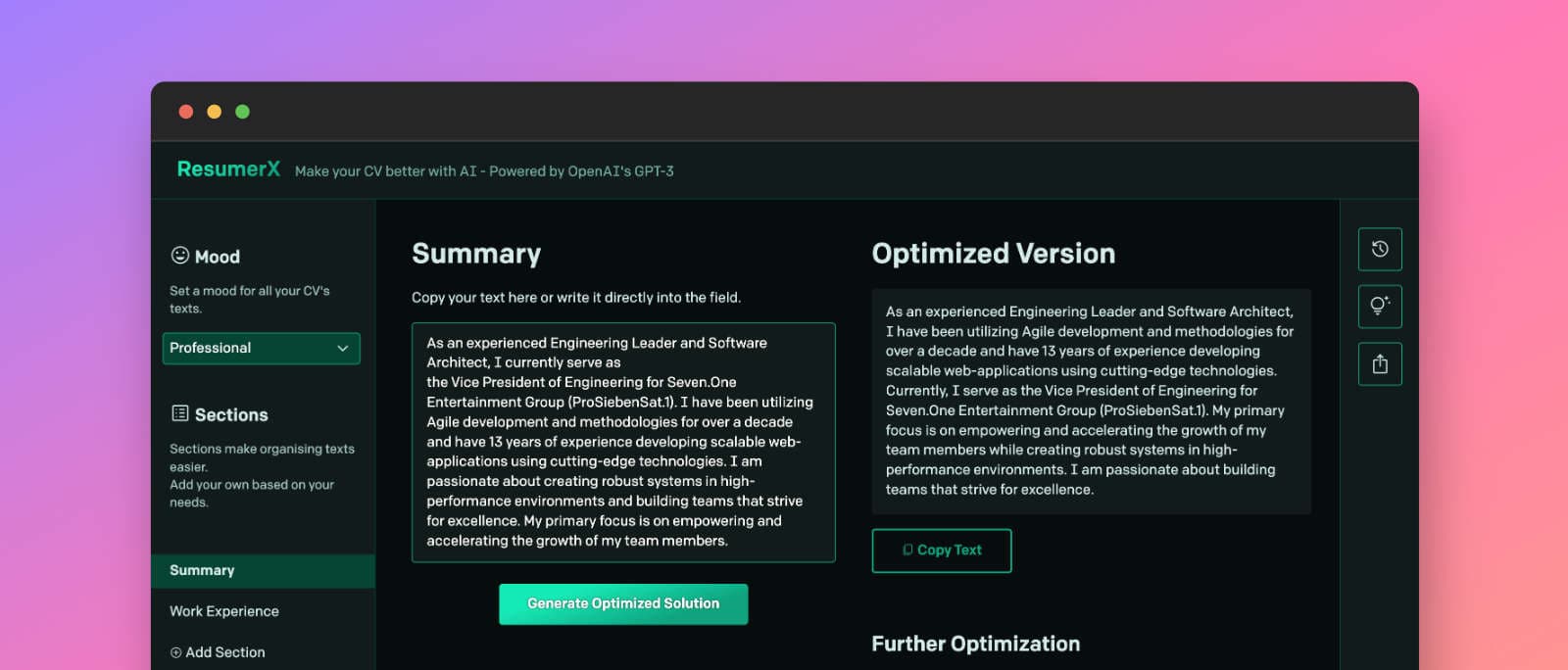
Introducing ResumerX - Elevate your CV using AI
Maximize your job search potential with the power of AI! As the buzz surrounding OpenAI's GPT-3 grows, I discovered its amazing potential for enhancing CVs. With the job market competitive, a standout resume is crucial for landing your next job. That's why I developed ResumerX, a tool leveraging OpenAI's API to elevate your CV and give you an edge in the interview process.
Read more
Introducing Warhol
Warhol turns pattern libraries into test suites. It helps you to enforce a unified look and feel for your web project, no matter how large and complicated the project may be. Warhol learns from the examples in a pattern library and supports you in implementing a truly consistent user experience.
Read moreSimplicity in Front-End Tooling
We tend to solve a lot of problems related to the front-end by delegating them to existing programs. We use libraries and tools which we don’t understand completely - our code base grows and grows. But lately this trend seems to change and we slowly re-consider what we can do best: develop front-end code. What can we expect from this new trend and how can we use them in out daily business today?
Read moreTesting ES6 Modules with Mocha using Babel with Browserify
When writing JavaScript applications or websites a lot of developers write unit tests to ensure the code does what it is supposed to do. The hottest code uses ES6 and transpiles to ES5 with Babel. Mocha is pretty popular as a testing framework these days. Bringing these tools together can be cumbersome. Here is how you do it.
Read moreUsing npm as a build system for your next project
npm is a Node.js’ dependency management system. It provides a script object in a project’s package.json configuration which can hold several CLI scripts. It is possible to run those via your command line. This way it is possible to replace your current build system. This article covers more about how you replace different tasks of a typical front-end build workflow.
Read moreIntroducing INIT – A Boilerplate Framework for Front-End Projects
INIT is based upon HTML5 Boilerplate and adds more structure for SCSS files, JavaScripts, includes build tasks and a whole lot more. Today we released INIT, a front-end framework based on Grunt, Bower, Karma and a lot more tools as version 1.0. This marks a special day for Anselm and me, as we worked for a long period to get this project to where it is today. Over at TNG I wrote a bit about why we need frameworks like these and what the challenges with current tools are: Generally we start a lot of our projects in kind of
Read more
Earlier
More from the archive
- Yeoman – Level-up Your Daily WorkflowAfter Yeoman was announced in the end of June while it was still in private beta developers were looking forward to use it soon. It was introduced as a tool that helps developers building web-apps while not having to care too much about the general boilerplate-coding to build a solid base for every project and to help performing tasks to bring your project into production. Now that Yeoman is available for everyone as Open Source the question how to use it in daily projects arises. I’ll try to give you a short overview on what you can expect from it
- An Approach on Building an Advanced Initial BoilerplateSince some time I found myself defining a good starting point for a new project over and over again. While I use HTML5 Boilerplate in nearly all of my projects it’s not enough as an initial package. Since I’m using SASS (in its dialect SCSS) and have some other things I define over and over again I decided to set up a package that lets me start easily and includes a lot of tools that are necessary for my projects. This is an introduction to init, the starting point for projects that require a bit more than just HTML5 Boilerplate.
- About Git's Cherry-PickingAt /gebrüderheitz we use Git as a version control system as we think this is the best to work together on a level which is easy to learn and work with. Before we used Git we’ve used SVN but this is by far not as flexible as Git. There are enough posts gathering the difference between Git and SVN so I will not cover any of these. When working in a team it’s important to keep your different stages of development in sync and control somehow: There is a front-end development going on which is in deep connection with the